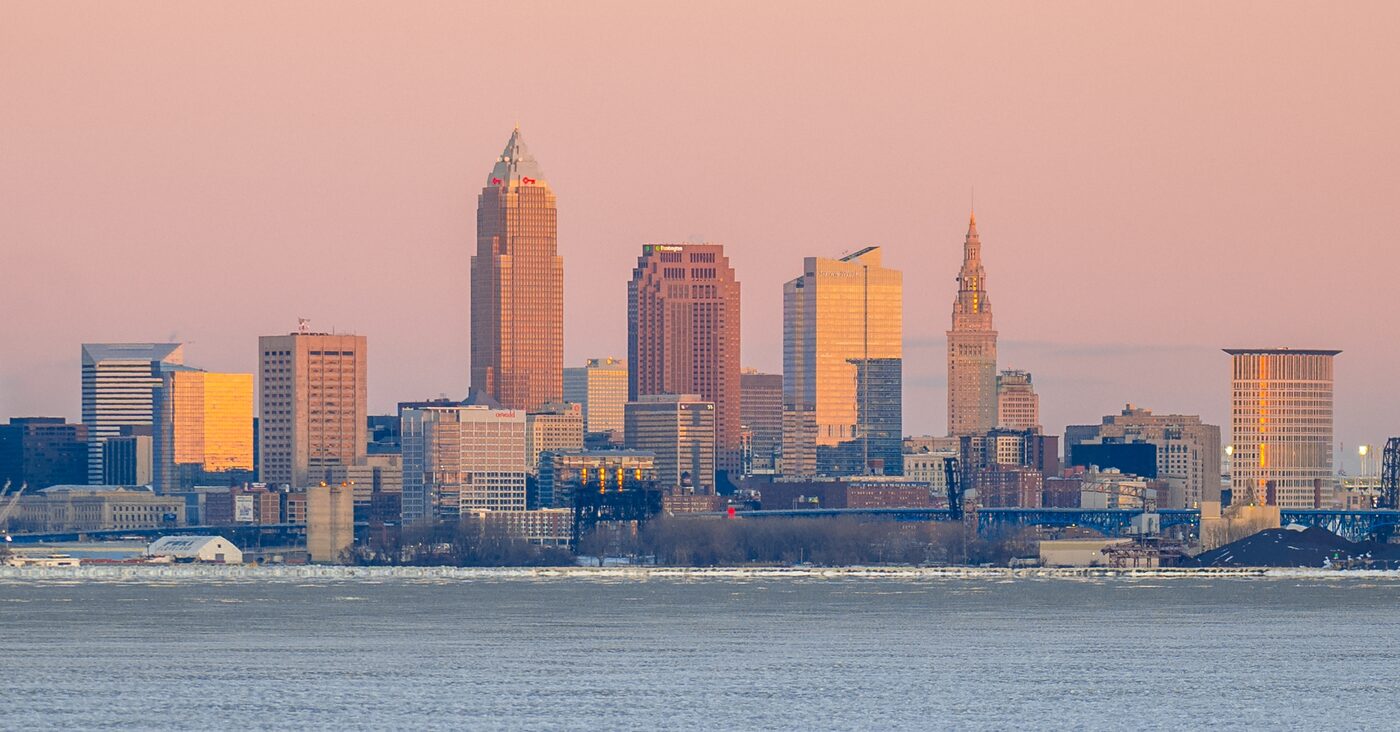
Cleveland: The Comeback City
Northeast Ohio • Population ~360,000 (metro 2M+) • On Lake Erie
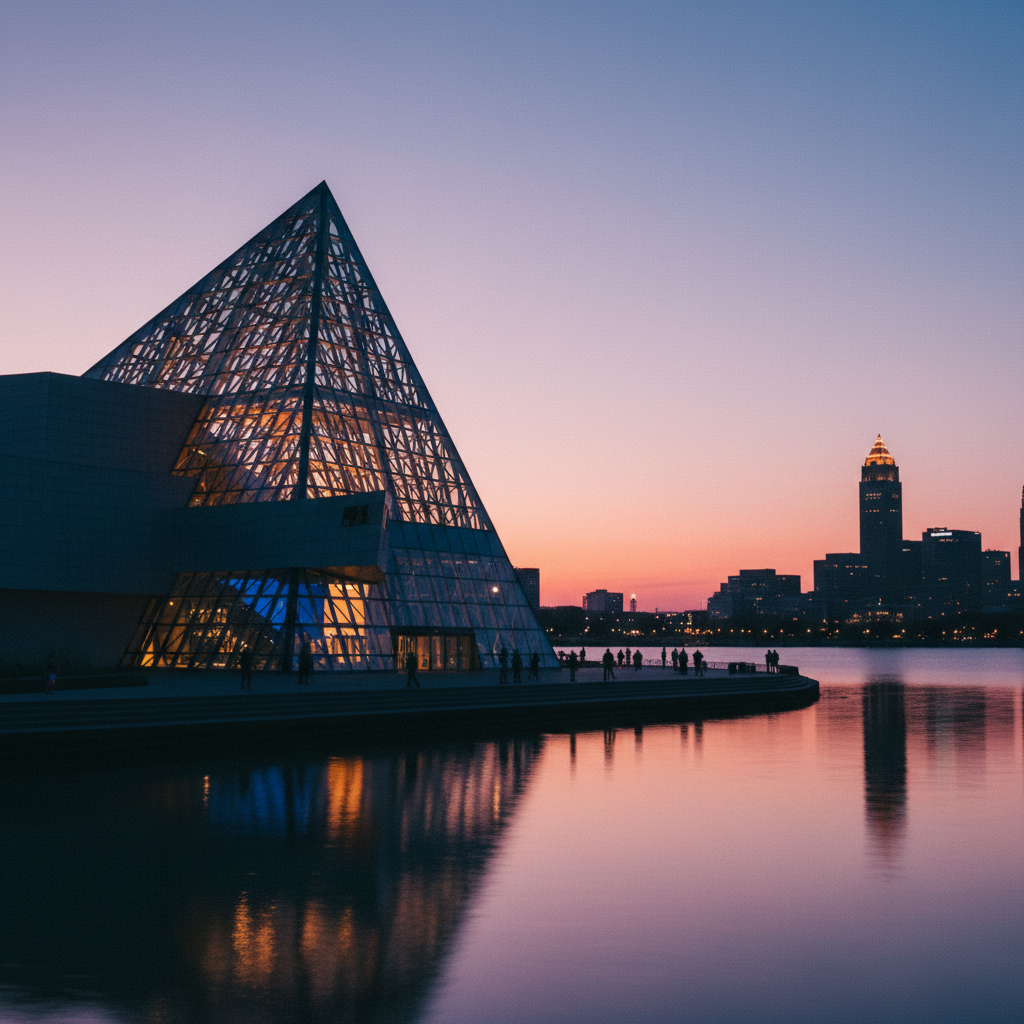 ROCK HALL • LAKE ERIE SHORE
Cleveland is the city that set its river on fire — the Cuyahoga River literally caught flame in 1969, so polluted it was combustible — and then turned that humiliation into the modern environmental movement. The Clean Water Act, the EPA, Earth Day: all of it traces back, in part, to Cleveland's burning river. Most cities would hide from that history. Cleveland put it on a T-shirt. That tells you everything you need to know about this town.
The Rock and Roll Hall of Fame sits on Lake Erie's shore, and it's here because Cleveland earned it. Alan Freed, a Cleveland disc jockey, coined the term "rock and roll" in the early 1950s and organized the first major rock concert — the Moondog Coronation Ball in 1952 at Cleveland Arena. The building itself, designed by I.M. Pei, is a glass pyramid that looks like it was dropped from space onto the lakefront. Inside, the history of American popular music unfolds across multiple floors, from Elvis's jumpsuit to Jimi Hendrix's Stratocaster.
But Cleveland's cultural credentials go far beyond rock. The Cleveland Museum of Art is genuinely world-class — a permanent collection spanning 6,000 years across 45,000+ works — and it is completely free. Free. One of the finest art museums in the country, and it costs nothing to walk in. This is the kind of thing Cleveland does that nobody outside Ohio seems to know about.
Playhouse Square is the largest performing arts center in the United States outside of New York City. Eleven theaters. Broadway shows, ballet, opera, concerts. The restored theaters are architectural stunners with ornate ceilings and gilded details from the 1920s. The outdoor chandelier display on Euclid Avenue — the world's largest — signals that you've arrived in a neighborhood that takes the arts seriously.
On the west side, the West Side Market has been operating since 1912, a massive indoor-outdoor market hall with over 100 vendors selling everything from fresh pierogi and Hungarian sausage to locally roasted coffee and artisanal cheese. The vaulted ceiling and Guastavino tile work make it feel like a European market hall, because that's exactly what it was modeled on.
Cleveland's neighborhoods tell the story of its immigrant heritage. Little Italy clusters along Mayfield Road near University Circle, packed with family-owned restaurants, bakeries, and galleries. AsiaTown along Payne Avenue serves some of the best dim sum and pho between New York and Chicago. And Tremont, once a working-class enclave, has reinvented itself into one of the best dining and gallery neighborhoods in the Midwest.
You should also know about A Christmas Story House — the actual house from the 1983 film, restored to its movie appearance and open for tours on West 11th Street. Across the street is a museum packed with original props and costumes. It's one of the most visited movie locations in America, and yes, the leg lamp is in the window.
Karamu House, founded in 1915, is the oldest African American theater in the United States. It premiered works by Langston Hughes and has been a cornerstone of Black arts and culture in Cleveland for over a century. It's a national treasure hiding in plain sight.
Cleveland is the city of the Dawg Pound, of LeBron's promise kept, of Drew Carey's famous declaration: "Cleveland rocks!" It rocks because it earned the right to rock — through steel mills and layoffs, through Art Modell's betrayal and a burning river, through decades of being the punchline and coming back harder every time.
Columbus: The One That Won't Stop Growing
Central Ohio • Population ~900,000 (metro 2.1M+) • State Capital
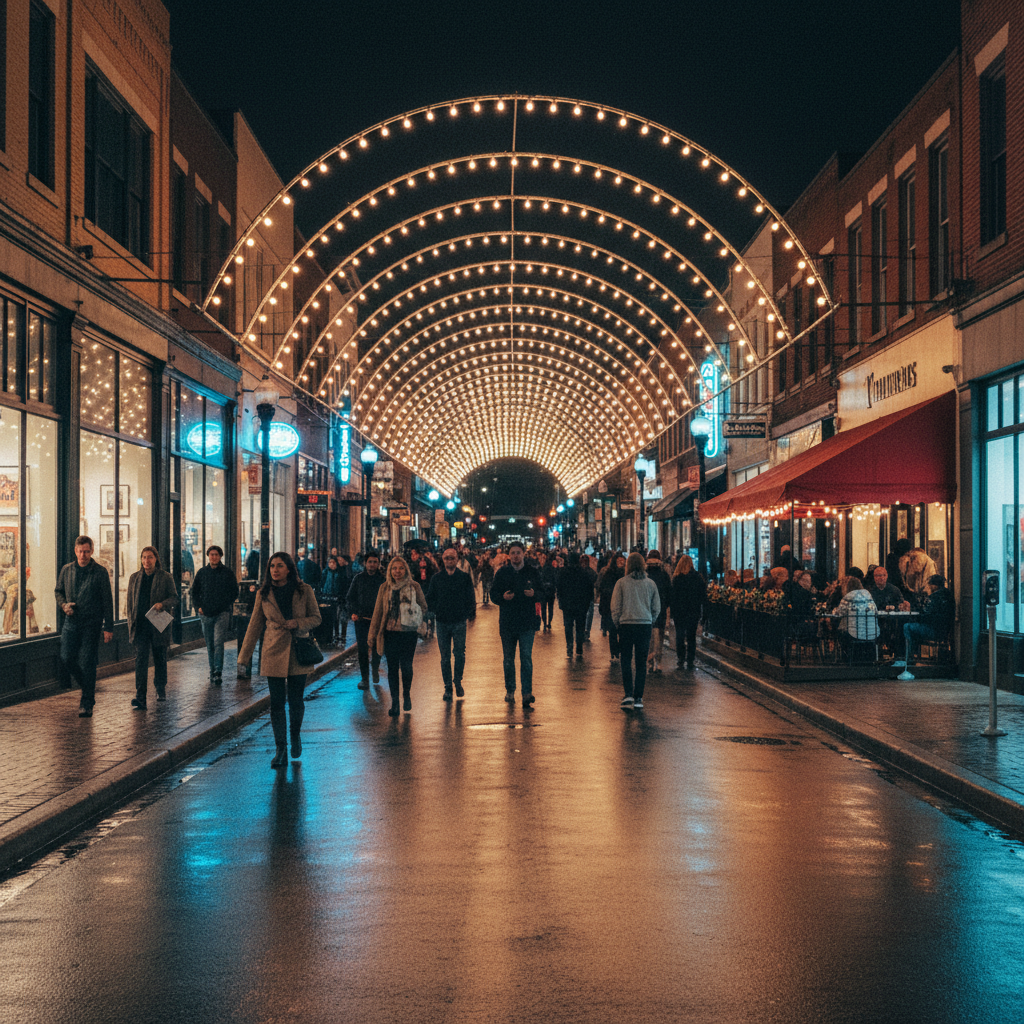 SHORT NORTH • HIGH STREET
Columbus is the fastest-growing major city in the Midwest, and it has been for years. While Cleveland and Cincinnati traded on legacy and grit, Columbus quietly became the biggest city in Ohio, and now the 14th largest in the United States. The population has nearly doubled since 1980. Intel is building a $20 billion semiconductor facility nearby. Amazon, Google, Facebook — they're all expanding here. Columbus is what happens when a city bets on education, technology, and relentless optimism.
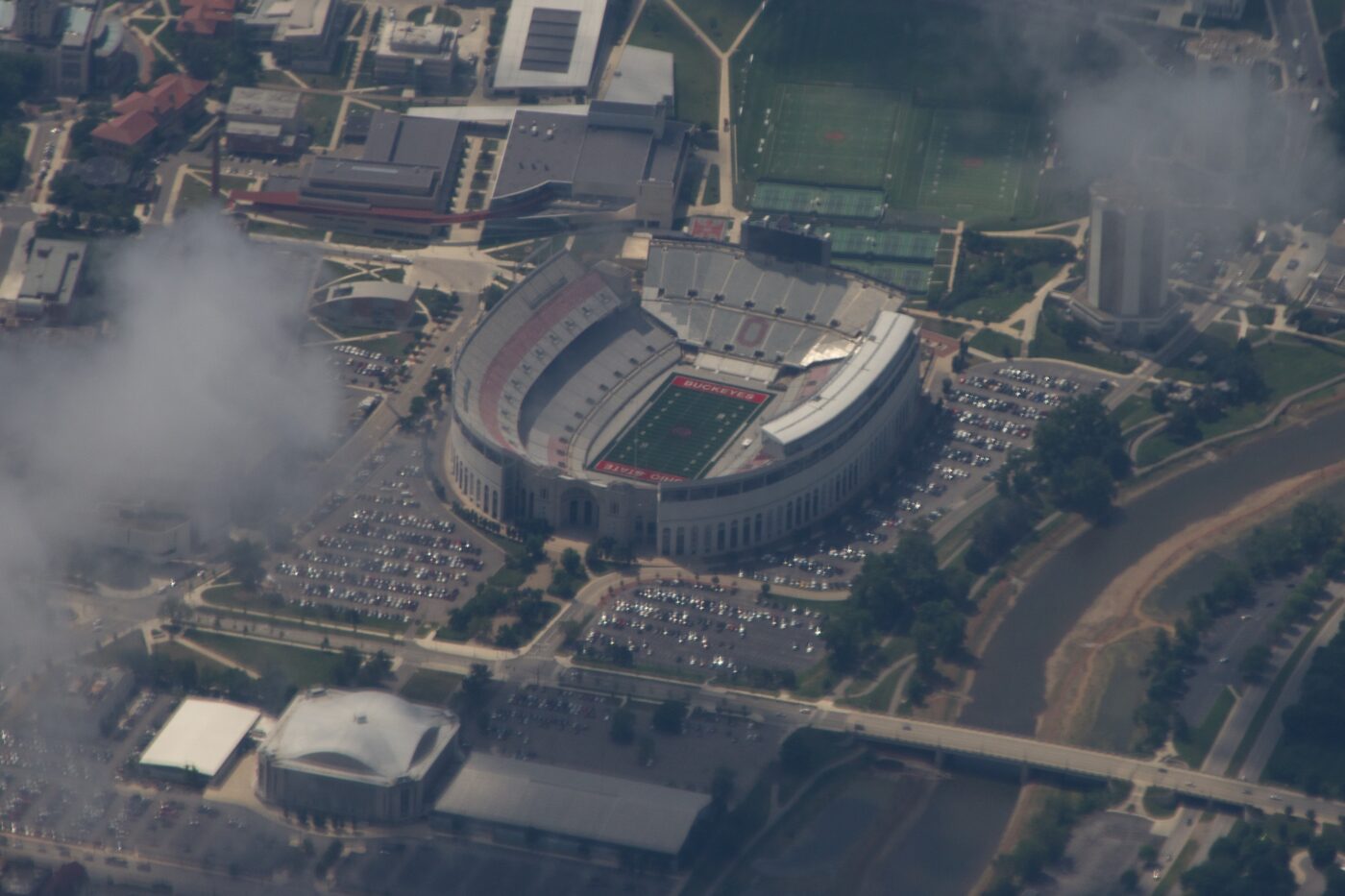
The center of gravity is Ohio State University and its cathedral, Ohio Stadium — "The Horseshoe." On game days, the stadium fills with over 100,000 people and becomes the third-largest city in Ohio. The "O-H! I-O!" call-and-response is a statewide reflex, but Columbus is where it lives and breathes. (See our full Ohio State deep dive for the full picture of this obsession.)
The Short North Arts District runs along High Street between downtown and the OSU campus, a mile-long corridor of galleries, boutiques, restaurants, and bars that has become one of the most vibrant urban neighborhoods in the Midwest. The monthly Gallery Hop on the first Saturday of each month draws thousands. The murals, the neon, the energy — the Short North is Columbus's answer to the question "What do you do for fun?"
German Village, just south of downtown, is a 233-acre historic district of 19th-century brick homes, cobblestone streets, and iron fences. It's one of the largest privately funded historic preservation districts in the country. The architecture is stunning, the restaurants are excellent, and The Book Loft — a 32-room independent bookstore housed in a series of connected pre-Civil War buildings — is a destination unto itself.
COSI (Center of Science and Industry) is one of the top science museums in the country, consistently ranked in the top tier nationally. It's the kind of place where adults without children have zero shame about spending an entire afternoon. The planetarium, the energy exhibits, the dinosaur gallery — COSI does it all and does it well.
The Columbus Zoo and Aquarium became nationally famous thanks to Jack Hanna, the zoo director who became a fixture on late-night television, bringing animals onto Letterman and turning a regional zoo into a world-class institution. The zoo consistently ranks among the best in the country.
And then there's Topiary Park in the Old Deaf School Park, where sculpted yew trees recreate Georges Seurat's painting A Sunday Afternoon on the Island of La Grande Jatte. An entire Impressionist masterpiece rendered in living topiary, sitting quietly in a Columbus park. It's beautiful, unexpected, and deeply weird in the best possible way.
Speaking of deeply weird: the Field of Corn in Dublin, just northwest of Columbus. 109 concrete ears of corn, each over six feet tall, standing in rows in a public park. It was created by artist Malcolm Cochran to honor Sam Frantz, a corn researcher. Locals call it Cornhenge. It's one of Ohio's most wonderfully bizarre landmarks, and if you need more of this energy, our Weird & Wonderful page is calling your name.
Cincinnati: Old Soul, New Energy
Southwest Ohio • Population ~310,000 (metro 2.2M+) • On the Ohio River
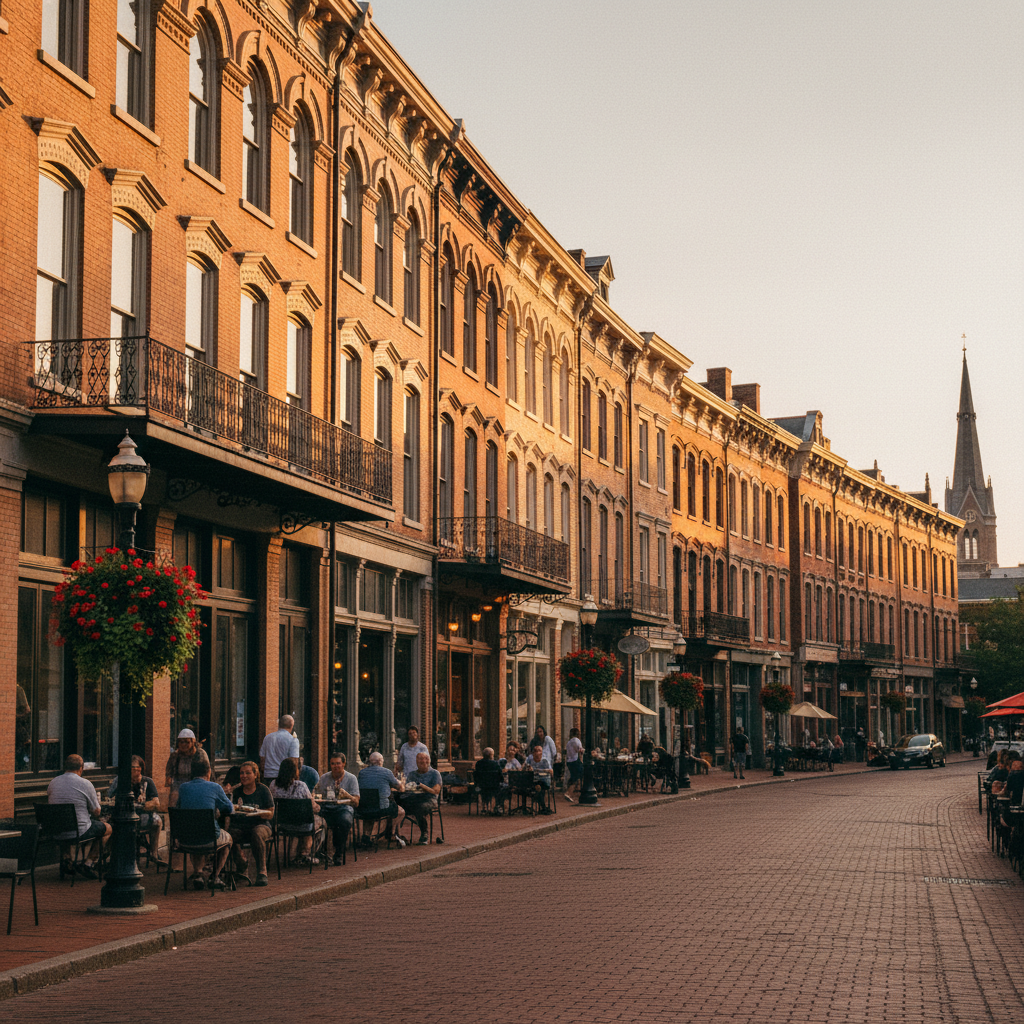 OVER-THE-RHINE • ZINZINNATI
Cincinnati is the Ohio city that feels least like it's in Ohio. It feels like it's in some alternate-universe version of a European river city that happened to land in the American Midwest. The hills, the river, the 19th-century architecture, the brewing heritage — Cincinnati has a texture and personality that is entirely its own.
Over-the-Rhine (OTR) is the neighborhood that tells Cincinnati's story in brick and stone. Built by German immigrants in the mid-1800s, it's the largest collection of Italianate architecture in the United States — block after block of ornate cornices, arched windows, and intricate brickwork. For decades, OTR was neglected and dangerous. Today, it's one of the most exciting dining, drinking, and nightlife districts in the Midwest, a stunning revival that preserved the architecture while filling the ground floors with craft breweries, cocktail bars, independent restaurants, and galleries. The transformation of OTR is one of the great urban revitalization stories in America.
Findlay Market, nestled in OTR, is Ohio's oldest continuously operated public market, running since 1852. Saturday mornings at Findlay Market are a sensory overload: fresh produce, butcher shops, flower stalls, baked goods, international food vendors, and live music. It predates the Civil War and hasn't slowed down.
The Cincinnati Museum Center is housed in the Union Terminal, an Art Deco masterpiece built in 1933 that is arguably the most beautiful train station in America. The half-dome facade is an icon. Inside, the rotunda murals by Winold Reiss depicting Cincinnati's history and industries are breathtaking. The building now houses a natural history museum, a history museum, a children's museum, and an OMNIMAX theater. Even if you don't go inside, stand in the rotunda and look up. You'll understand.
Great American Ball Park sits right on the Ohio River, and a Reds game at sunset — the river golden, the Kentucky hills across the water, the crowd settling in — is one of the most beautiful experiences in American sports.
The John A. Roebling Suspension Bridge, connecting Cincinnati to Covington, Kentucky, was completed in 1866 and was the longest suspension bridge in the world at the time. If it looks familiar, there's a reason: Roebling used it as the prototype for the Brooklyn Bridge. Cincinnati had it first.
Music Hall, a National Historic Landmark built in 1878, is home to the Cincinnati Symphony Orchestra, the Cincinnati Opera, and the Cincinnati Ballet. The Venetian Gothic architecture is dramatic. The acoustics are superb. And the building is rumored to be haunted, built as it was atop a pauper's burial ground — bones have been discovered during renovations. Because of course they have.
Oktoberfest Zinzinnati is the largest Oktoberfest celebration in the United States, drawing over 500,000 people annually to downtown Cincinnati. The German heritage runs deep here — the city was nicknamed "Zinzinnati" by its German-speaking founders — and the festival is a massive, multi-block celebration of beer, bratwurst, and gemutlichkeit.
And then there's the chili. Cincinnati-style chili is a phenomenon unto itself — Mediterranean-spiced, served over spaghetti, topped with an architectural mound of shredded cheese. It has its own ordering system (three-way, four-way, five-way). Skyline Chili and Gold Star have waged a cold war for decades. People have strong opinions. Very strong opinions. We gave Cincinnati chili its own section on our food page because it demanded one.
Dayton: Where Flight Began
West-Central Ohio • Population ~135,000 (metro 800,000+)
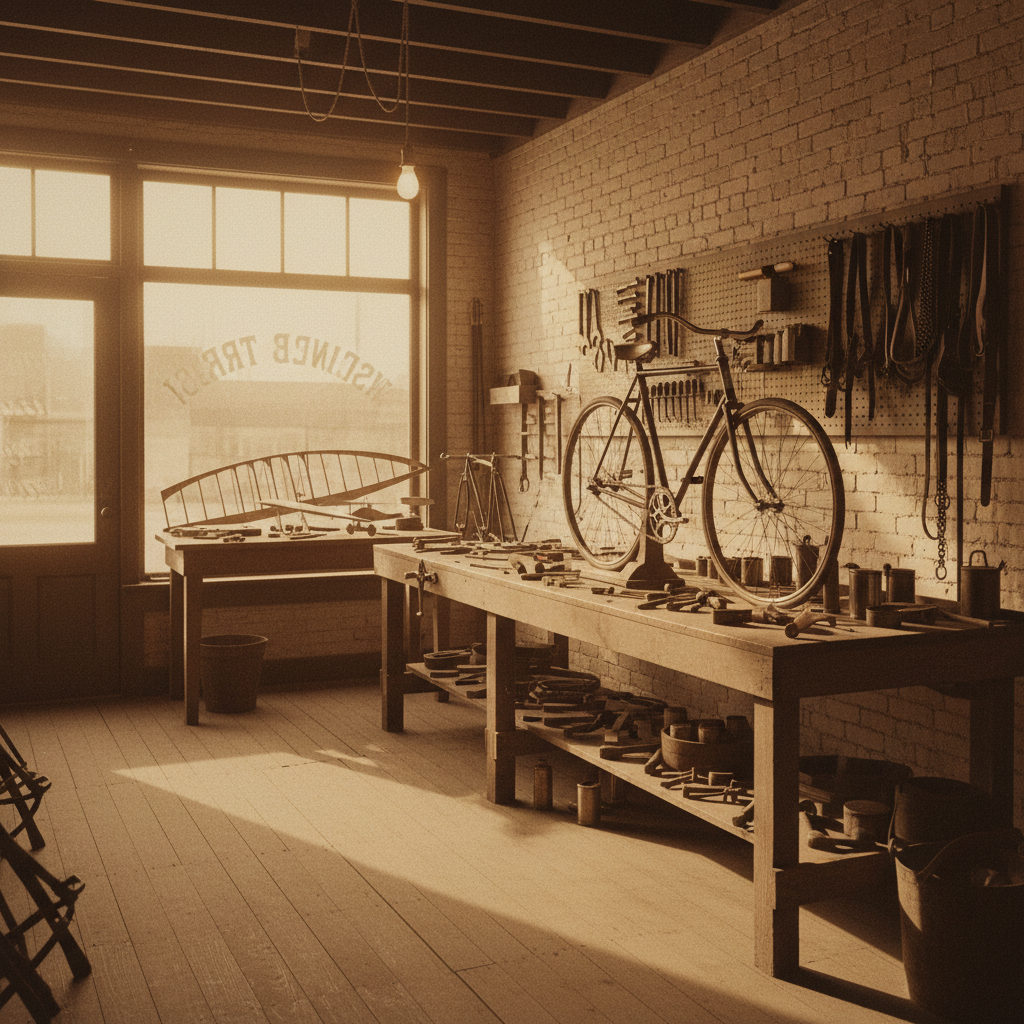 22 S. WILLIAMS ST • CIRCA 1900
Dayton's claim to fame is simple and staggering: this is where human flight was invented. Wilbur and Orville Wright ran a bicycle shop at 22 South Williams Street, and in that shop and at nearby Huffman Prairie, they worked out the fundamental problems of aerodynamics, wing warping, and powered flight that would change the world. Kitty Hawk gets the postcard, but the Wright Brothers were Dayton men, and Dayton is where the real work happened.
The National Museum of the United States Air Force, located at Wright-Patterson Air Force Base, is the world's largest and oldest military aviation museum. It is free. Four massive hangars hold over 350 aircraft and missiles, from a replica of the 1903 Wright Flyer to stealth bombers, presidential aircraft (including the actual Air Force One that carried JFK's body from Dallas), and an Apollo 15 command module. You could spend an entire day and not see everything. Many people do exactly that.
Wright-Patterson is also the home of Hangar 18 — the legendary facility where, according to UFO lore, debris and possibly bodies from the 1947 Roswell crash were supposedly taken for analysis. The Air Force denies it. Believers insist. The base was also headquarters for Project Blue Book, the official U.S. Air Force investigation of UFO sightings that ran from 1952 to 1969. Over 12,000 sightings were investigated. Most were explained. Some were not. Whether you believe in extraterrestrial visitors or not, the fact that the U.S. government ran its UFO investigation out of Dayton for 17 years adds a layer of mystery to the city that you won't find in the tourism brochures.
Dayton also played a secret role in ending World War II. The Dayton Project was the classified effort, running in parallel with the Manhattan Project, where a team led by Charles Allen Thomas refined the polonium initiator that triggered the first nuclear weapons. The work was done at a downtown Dayton facility, hidden in plain sight. Most Daytonians had no idea their city was helping build the atomic bomb. For the full story, see our Legends page on Ohio's atomic secrets.
Modern Dayton has leaned into its innovation heritage. The Dayton Aviation Heritage National Historical Park preserves the Wright Brothers' story across multiple sites. The Oregon District, Dayton's historic entertainment neighborhood, fills 19th-century buildings with restaurants, bars, and live music. And the city's engineering and defense sector — anchored by Wright-Patterson — keeps Dayton punching above its weight in technology and research.
Smaller Cities Worth Knowing
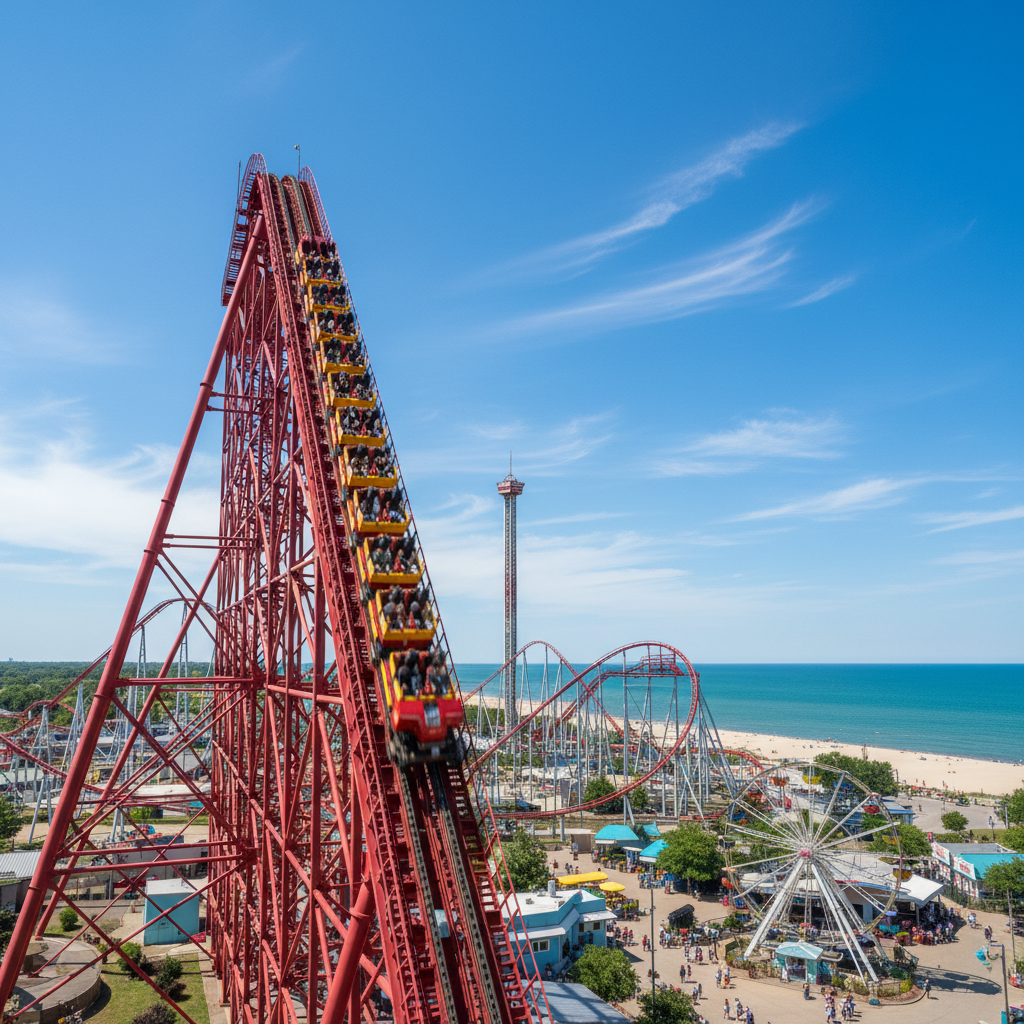 SANDUSKY • COASTER CAPITAL
Ohio's four major cities get the spotlight, but the state's smaller cities have stories of their own that deserve more than a footnote.
Canton
Home of the Pro Football Hall of Fame. The NFL was organized here in 1920, and every August, the city hosts the Hall of Fame Game and enshrinement ceremony. Canton is professional football's hometown, and the bronze busts of every inducted player are a pilgrimage site for fans. See our Sports page for more.
Akron
The Rubber Capital of the World — Goodyear, Firestone, General Tire, and B.F. Goodrich were all headquartered here. Akron gave us LeBron James, who grew up in the city's public housing and became the greatest basketball player of his generation. Akron also gave us Devo, the band that asked "Are we not men?" and answered with flower pots on their heads. Rubber, royalty, and new wave. Only in Akron.
Toledo
Sitting at the western tip of Lake Erie, Toledo is famous for Tony Packo's — the Hungarian hot dog restaurant immortalized on M*A*S*H by Jamie Farr (a Toledo native). Toledo was also the subject of the Toledo War of 1835, a bloodless border dispute between Ohio and Michigan over a strip of land. Ohio won. Michigan got the Upper Peninsula as a consolation prize and arguably got the better deal.
Sandusky
Gateway to Cedar Point, the undisputed roller coaster capital of the world. Seventeen coasters, including some of the tallest, fastest, and most terrifying on the planet. Cedar Point alone draws 3.5 million visitors per year. See our Nature page for the Lake Erie Islands nearby.
Put-in-Bay
On South Bass Island in Lake Erie, accessible only by ferry or small plane. It's part historic site — Perry's Victory and International Peace Memorial commemorates the Battle of Lake Erie in the War of 1812 — and part party town, where golf carts replace cars and the bars fill up by noon in summer. It's Ohio's version of Key West, except with walleye instead of marlin.
"Cleveland set its river on fire and started an environmental movement. Columbus won't stop growing. Cincinnati had the Brooklyn Bridge first. Dayton invented flight. Four cities. Four personalities. All Ohio."