

The Loveland Frogman
Loveland, Ohio • Little Miami River
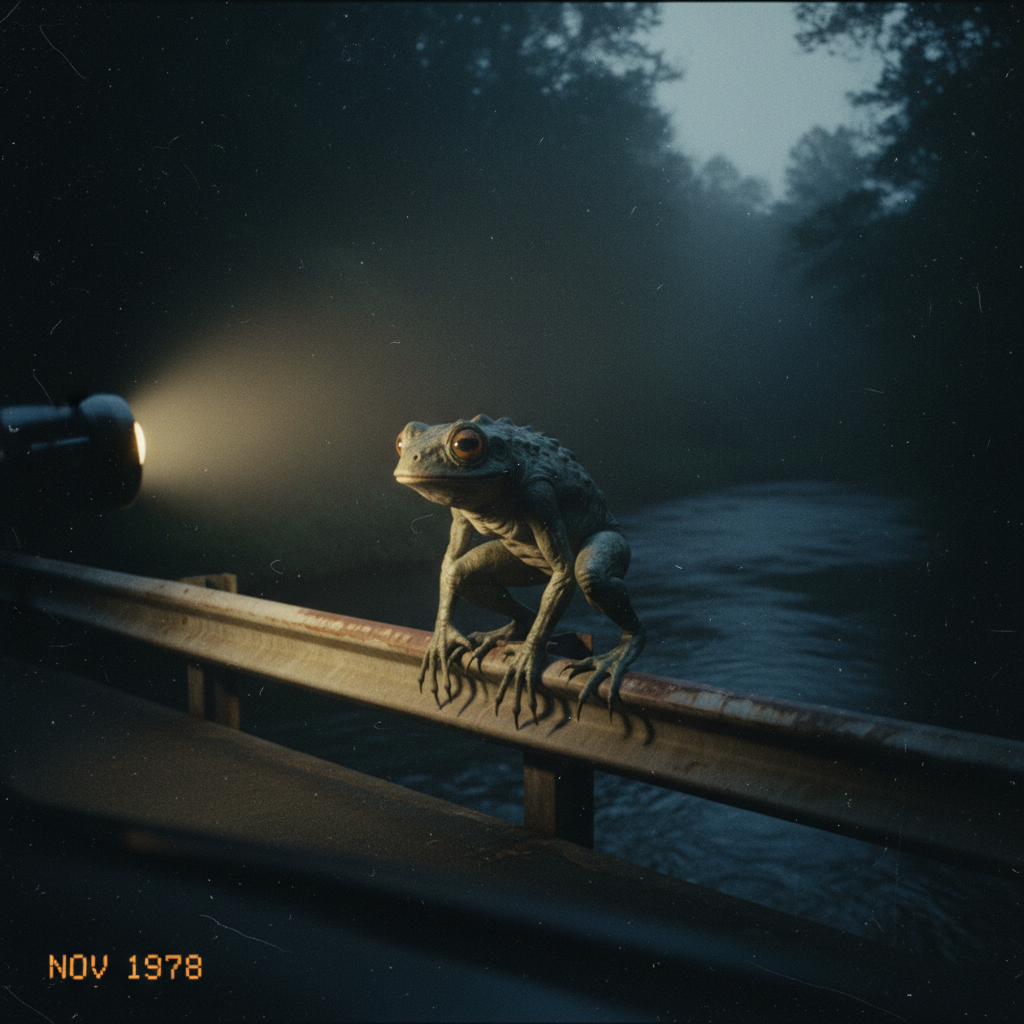 POLICE REPORT • 1972
Ohio's signature cryptid has a pedigree that most alleged monsters can only dream of: multiple police officer witnesses, a sighting record stretching back 70 years, and — as of 2023 — official municipal mascot status.
The story begins not in the 1970s, as most accounts suggest, but in 1955. A Loveland businessman named Robert Hunnicutt was driving near a bridge on the Little Miami River when he spotted three bipedal, frog-faced entities standing by the roadside. One was holding a wand-like device that emitted sparks. Hunnicutt reported the encounter but, being the Eisenhower era, the story stayed local.
Then came the encounters that made the Frogman famous.
On March 3, 1972, at approximately 1:00 AM, Loveland Police Officer Ray Shockey was driving his patrol car along Riverside Drive near the Totes Boot Factory. His headlights swept across what he initially took to be a dog or a piece of debris in the road. Then it moved. The crouched figure stood upright — roughly four feet tall, with leathery skin, a frog-like head, and large prominent eyes — and vaulted the guardrail, descending the embankment toward the Little Miami River. Shockey radioed the encounter in immediately.
Exactly two weeks later, on March 17, Officer Mark Matthews encountered a similar creature in the same area. This time, the officer didn't just observe — he fired his sidearm at it. The creature escaped into the river.
Fortean investigator Ron Schaffner interviewed both officers in 1976. They confirmed that a composite drawing matched what they'd seen. The officers stood by their accounts for years. But in 2016, in an interview with WCPO Cincinnati, Matthews offered a different explanation: his creature was actually "a large tailless iguana." Shockey has never publicly retracted his account.
The Loveland Frogman has appeared in two subsequent waves of sightings — a set of reports around Lake Isabella in 2016, and scattered encounters near the bike trail in the early 2020s. In August 2023, the city of Loveland made it official: the Loveland Frog became the city's official mascot, emblazoned on signs and merchandise. The creature that two police officers couldn't explain now welcomes you to town.
The Grassman (Ohio's Bigfoot)
Salt Fork State Park, Guernsey County • 17,000 acres
 SALT FORK • FIELD REPORT
Every state with wilderness has Bigfoot sightings. Ohio has 330+ documented encounters, ranking among the top five nationally. But Ohio's variant has a name of its own — the Grassman — and it is distinguished by one strange behavioral detail: it builds woven grass nests.
The epicenter is Salt Fork State Park in Guernsey County, Ohio's largest state park at 17,000 acres of dense, hilly forest. Sightings cluster in the ravines and hollows of the park's interior, far from the campgrounds and fishing lakes that draw weekend visitors.
But the most dramatic encounter didn't happen at Salt Fork. It happened near Minerva in 1978, and it terrorized the Cayton family for weeks.
The family reported repeated visits from a creature standing approximately seven feet tall and weighing an estimated 300 pounds. It pounded their walls. It threw rocks onto their roof. It circled the house at night. And then, one morning, the family found their German Shepherd — a strong, healthy dog — dead in the yard with a broken neck.
On August 21, during a party at the Cayton home, multiple guests witnessed two pairs of glowing eyes watching them from the chicken coop. The Caytons eventually moved.
Don Keating of Newcomerstown has documented 36+ sightings since the 1980s and hosts the Annual Bigfoot Conference at Salt Fork Lodge — the world's longest-running Bigfoot research conference. The event draws hundreds of attendees, field researchers, and the genuinely curious. Salt Fork has embraced its reputation: the park gift shop sells Bigfoot souvenirs, and rangers will, if pressed, acknowledge that "people see things out here."
The Grassman differs from the Pacific Northwest Sasquatch in several reported ways: it is described as having a flatter face, a more aggressive temperament, and an apparent preference for building temporary shelters from woven grasses and branches — hence the name. Whether this represents a genuine unknown primate, a series of misidentifications, or collective folklore reinforced over decades, Salt Fork remains Ohio's most active zone of encounter.
The Melon Heads
Wisner Road, Kirtland • Lake County
 WISNER ROAD • DO NOT TRESPASS
The Melon Heads of Wisner Road may be Ohio's most unsettling legend. Not because the creatures are the most dangerous — they reportedly flee from humans — but because the origin stories are so dark that they unsettle regardless of belief.
The creatures are described as small humanoid figures with grotesquely enlarged, bulbous, bald heads, roaming the forests of eastern Lake County. Sightings cluster along Wisner Road in Kirtland and in the surrounding woods between the Holden Arboretum and the Chapin Forest Reservation.
Three origin stories compete, and all of them are grim:
- The Dr. Crow Version: A benevolent physician named Dr. Crow sheltered hydrocephalic orphans in a house on Wisner Road. When Dr. Crow died, the orphans — unable to care for themselves — escaped into the forest and survived as a feral colony. Their descendants, interbreeding in isolation, perpetuated the condition.
- The Mad Scientist Version: A doctor (sometimes named Crowe, sometimes unnamed) performed experiments on institutionalized children, injecting chemicals into their brains that caused their skulls to swell. The children eventually revolted, killed the doctor, and fled into the woods.
- The Government Experiment Version: A post-WWII government program experimented on orphaned children at a remote facility in Lake County. When the project was abandoned, the subjects were left to fend for themselves in the forest.
What makes the Melon Heads legend particularly compelling is the 1964 encounter. A group of teenagers in Wickliffe reported finding an old house set back from the road where they observed "several Melon Heads on the porch with an elderly couple" — suggesting the creatures were, at that time, still being cared for by human caretakers.
The legend has survived into the modern era. The 2024 film The Melon Heads: House of Crow sold out its premieres at Atlas Cinemas in Mentor, and Wisner Road remains a destination for adventurous drivers after dark — though Lake County authorities have posted extra signage discouraging trespassing.
South Bay Bessie
Lake Erie • Sighting record since 1793
 LAKE ERIE • UNCHARTED WATERS
Every great lake deserves a great lake monster, and Lake Erie has South Bay Bessie — a serpentine creature whose sighting record stretches back to 1793, making it one of the oldest continuously reported lake creatures in North America.
The most compelling modern report came in 1990, when the Harold Bricker family was enjoying a day near Cedar Point — Ohio's famous amusement park — and observed a creature approximately 35 feet long with a snake-like head moving through the water. The sighting lasted several minutes and was witnessed by multiple family members.
The creature attracted enough attention that marina owner Thomas Solberg once offered a $100,000 reward for the live capture of Bessie. The reward was never claimed.
South Bay Bessie was named after the Davis-Besse Nuclear Power Plant on the southern shore of Lake Erie — itself named after the nearby Davis and Besse families. The juxtaposition of a nuclear plant and a lake monster seems almost too perfectly Ohio.
Skeptics have a reasonable explanation: Lake Erie is home to lake sturgeon, prehistoric-looking fish that can reach nine feet in length, weigh over 200 pounds, and have a dinosaur-like appearance with bony plates and elongated snouts. A large sturgeon surfacing near a boat could easily be mistaken for something more exotic. But the sturgeon explanation doesn't fully account for the 35-foot length reported by the Brickers, or for sighting reports that describe a creature with a distinctly serpentine body moving at speed.
Ohio's 33 Crybaby Bridges
Across Ohio • More than any other state
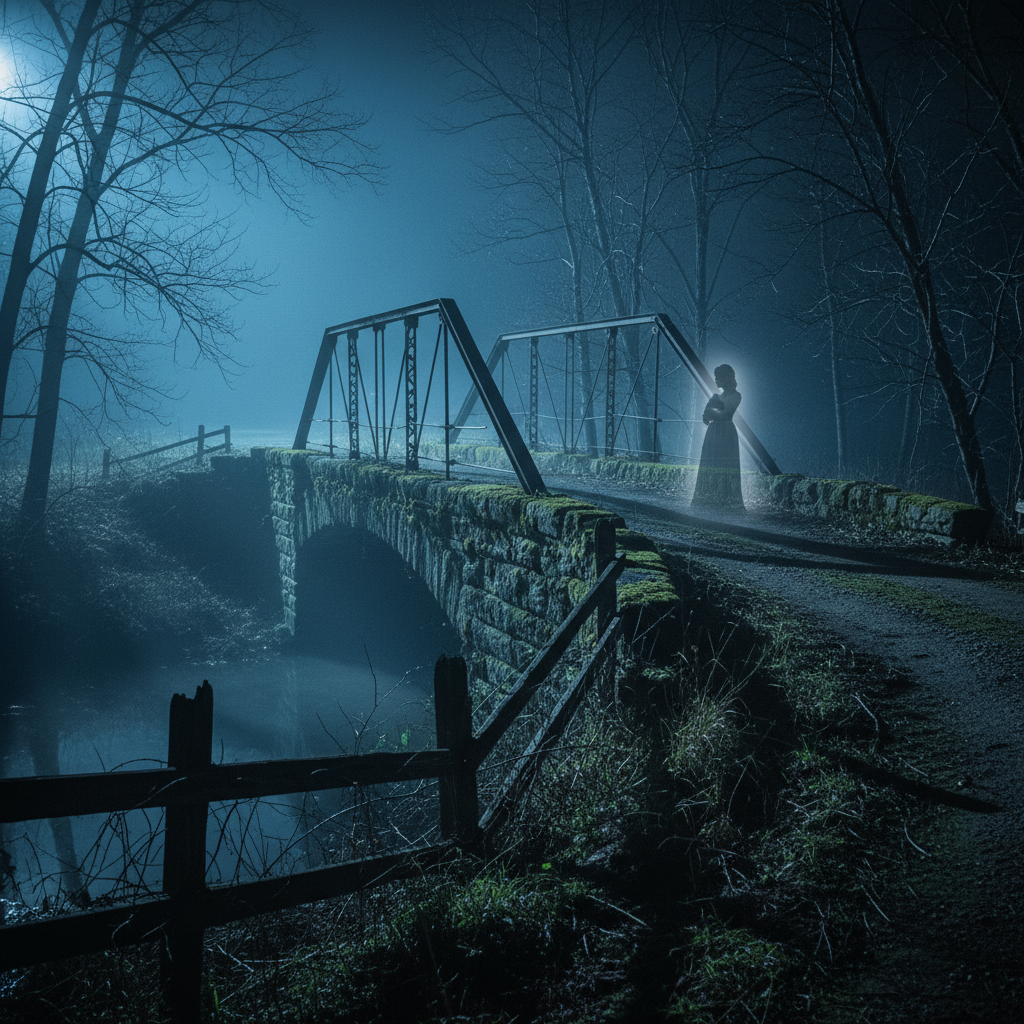 PALMER ROAD • EVP RECORDED
A "crybaby bridge" is a bridge where, according to legend, the sounds of a crying baby can be heard — usually attributed to the ghost of an infant thrown from the bridge, drowned beneath it, or abandoned near it. It's a common American folk legend type. What makes Ohio remarkable is the sheer density: researcher James Willis cataloged at least 33 crybaby bridges for his book Weird Ohio, more than any other state in America.
They're everywhere. Rural counties. Suburban townships. The backroads of Appalachian Ohio. Each bridge has its own story — a desperate mother, a terrible accident, a crime that was never solved — and each community insists their bridge is the real one.
The most documented investigation occurred at the Palmer Road bridge in Mercer County. On October 15, 2005, the Ohio Exploration Society conducted an EVP (electronic voice phenomena) session at the bridge. During the recording, investigators captured what they identified as a woman's voice saying "I will not deny my baby" followed by a cry so strong and clear that it recorded over an investigator's opening remarks — something that shouldn't be possible with the recording equipment being used.
Why Ohio has so many crybaby bridges is itself an interesting question. One theory suggests that Ohio's density of rural bridges — the state has an enormous number of small creek crossings on county roads — combined with its Appalachian storytelling traditions and its history of isolated rural communities, created the perfect conditions for this particular type of legend to propagate. Whatever the explanation, driving Ohio's back roads after dark remains, for many, a test of nerve.
"Ohio is a cryptid hotspot of remarkable density. The state has 330+ documented Bigfoot encounters, ranking among the top five nationally, and its menagerie of alleged creatures is among the most diverse in America."
The Supporting Cast
Ohio's cryptid file extends well beyond the headliners. The Orange Eyes of Charles Mill Reservoir near Mansfield was reported in 1963 by three teenagers who described a seven-foot, armless, glowing-eyed creature that emerged from the water. The Crosswick Monster of Warren County was reported in 1882 when farmers described a serpentine creature in the woods near the Little Miami River. The Peninsula Python was a recurring series of giant snake sightings in the Cuyahoga Valley in the 1940s that caused genuine panic and armed search parties.
And at Wright-Patterson Air Force Base near Dayton — the same base that housed the Dayton Project's atomic bomb secrets — there are the persistent rumors of Hangar 18 — the alleged storage facility for Roswell crash debris and alien remains. Senator Barry Goldwater publicly stated he tried to access the rumored "Blue Room" in the early 1960s but was denied by a furious General Curtis LeMay. The Air Force's official denial is characteristically emphatic: "There are not now, nor have there ever been, any extraterrestrial visitors or equipment on Wright-Patterson Air Force Base." The base does, however, contain buildings 18A through 18G.