The Seven-Story Basket
Newark, Ohio • 180,000 sq ft • Cost: $30 million
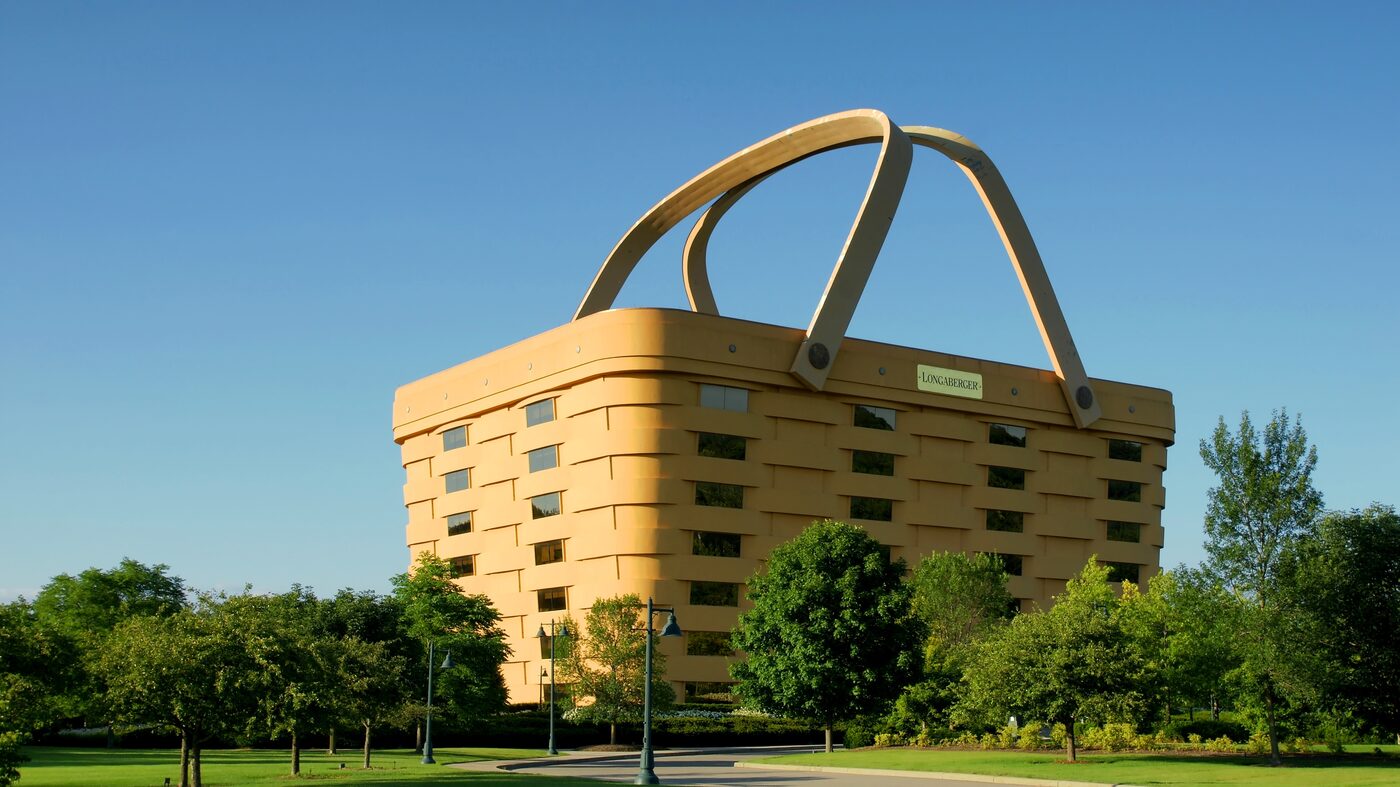
The Longaberger Basket Building is, without exaggeration, one of the most extraordinary pieces of corporate architecture ever constructed. Seven stories tall. 180,000 square feet of office space. An exact replica of a medium market basket at 160 times actual size. Two handles that weigh almost 150 tons and contain heating elements to prevent ice from accumulating and falling on people below.
Dave Longaberger, the company's founder, insisted on the design over the objections of architects who warned that a basket-shaped building was structurally and aesthetically inadvisable. Longaberger reportedly told them, "If they can put a man on the moon, they can build a building that looks like a basket." The building opened in 1997 at a cost of $30 million.
For years it served as the headquarters of the Longaberger Company, which manufactured handcrafted maple baskets and built an empire of home sales. At its peak, the company employed 8,200 people and had annual revenues of $1 billion. Then the market shifted. The company went bankrupt. The building sat empty.
The basket has since achieved cult status. When Heritage Ohio organized the first public tour in October 2019, 600 people showed up, many in tears. The building represents something that resonates deeply in Ohio: the combination of stubborn vision, impractical ambition, and the refusal to build something boring when you could build something magnificent. The basket is currently being redeveloped, but its identity as Ohio's most beloved piece of architectural weirdness is secure.
"Cornhenge"
Dublin, Ohio • 109 ears of concrete corn
 DUBLIN • 109 EARS • SINCE 1994
In 1994, the city of Dublin, Ohio unveiled an art installation that would confuse and delight visitors for decades: 109 concrete ears of corn, each standing over six feet tall and weighing 1,500 pounds, arranged in rows across a grassy field.
The installation, officially titled Field of Corn (with Osage Orange Trees), was created by artist Malcolm Cochran and honors Sam Frantz, a hybridized corn pioneer who developed improved corn varieties on the site. The ears are cast from molds of actual corn ears, scaled up to human height, and planted in the ground like a crop of concrete.
It is exactly as magnificent and bewildering as it sounds. Visitors pull over on the highway, walk among the corn, take photos, and try to figure out what, exactly, they're looking at. The installation has been variously described as "Ohio's Stonehenge," "the most Ohio thing in Ohio," and "proof that Dublin has too much public art funding and zero interest in reining it in." The corn doesn't care. The corn stands year-round, through snow and heat and tornado warnings, silent and enormous and profoundly Ohioan.
The Warther Museum: 7,500 Moving Parts, One Second-Grade Education
Dover, Ohio
 DOVER • 7,500 PARTS PER MODEL
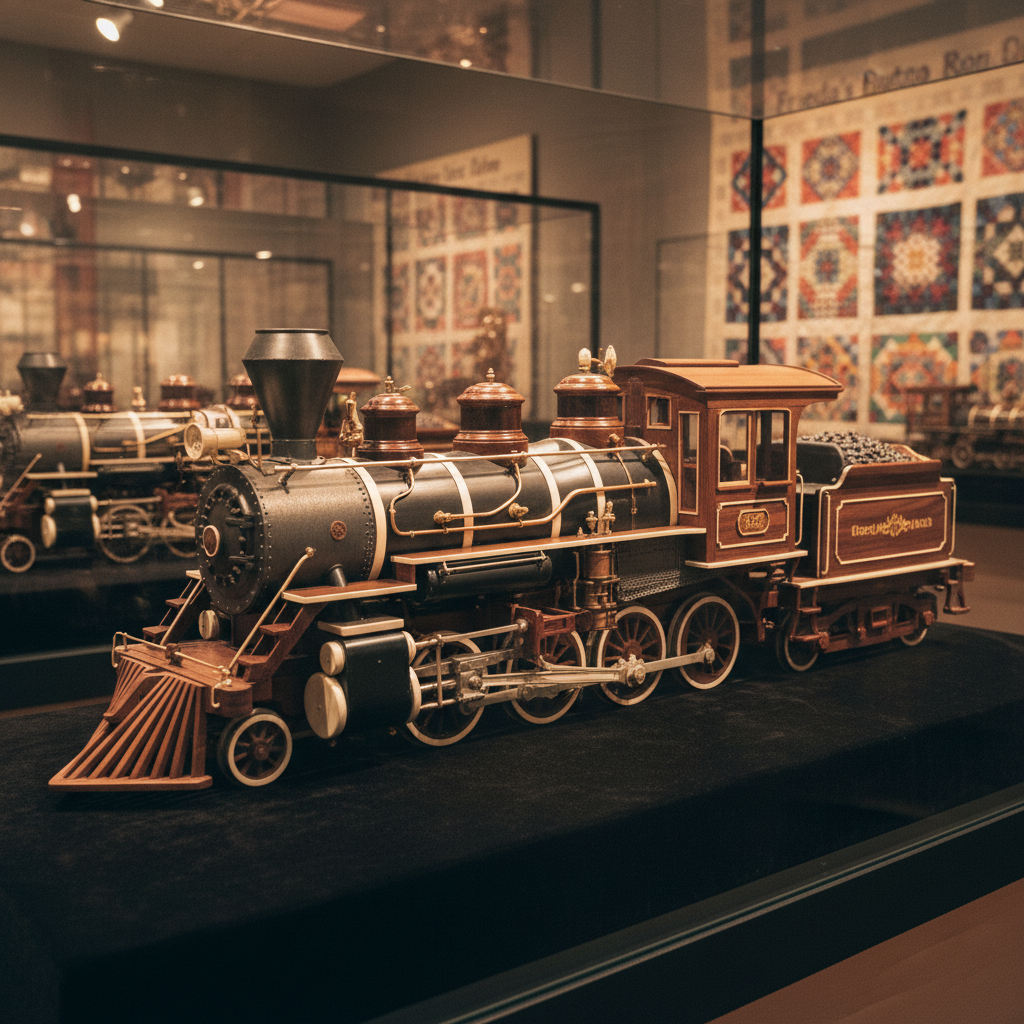
Ernest "Mooney" Warther (1885–1973) had a second-grade education, a set of carving knives, and an obsession with steam locomotion that produced one of the most extraordinary folk art collections in America.
The Warther Museum in Dover houses 64 scale-model steam locomotives carved from walnut, ebony, and ivory. Each model contains over 7,500 individual hand-carved pieces, and every component functions: pistons pump, connecting rods rotate, valves open and close. The Smithsonian appraised the collection as "priceless."
Henry Ford offered to buy the entire collection. Warther declined, saying his roof didn't leak, he wasn't hungry, and his wife Frieda "had all her buttons."
About those buttons. Frieda Warther maintained her own collection, and it is nearly as extraordinary as her husband's: 73,282 buttons sewn onto fabric panels in intricate geometric patterns. The button collection fills an entire room of the museum and represents decades of methodical, obsessive craftsmanship.
Warther refused to carve diesel locomotives, which he hated. His collection stops at the end of the steam era. It is a monument to one man's singular focus: he found the thing he loved, he spent his entire life perfecting his understanding of it, and he built something that the nation's greatest museum couldn't put a price on.
The Hartman Rock Garden
Springfield, Ohio • 250,000 individual stones
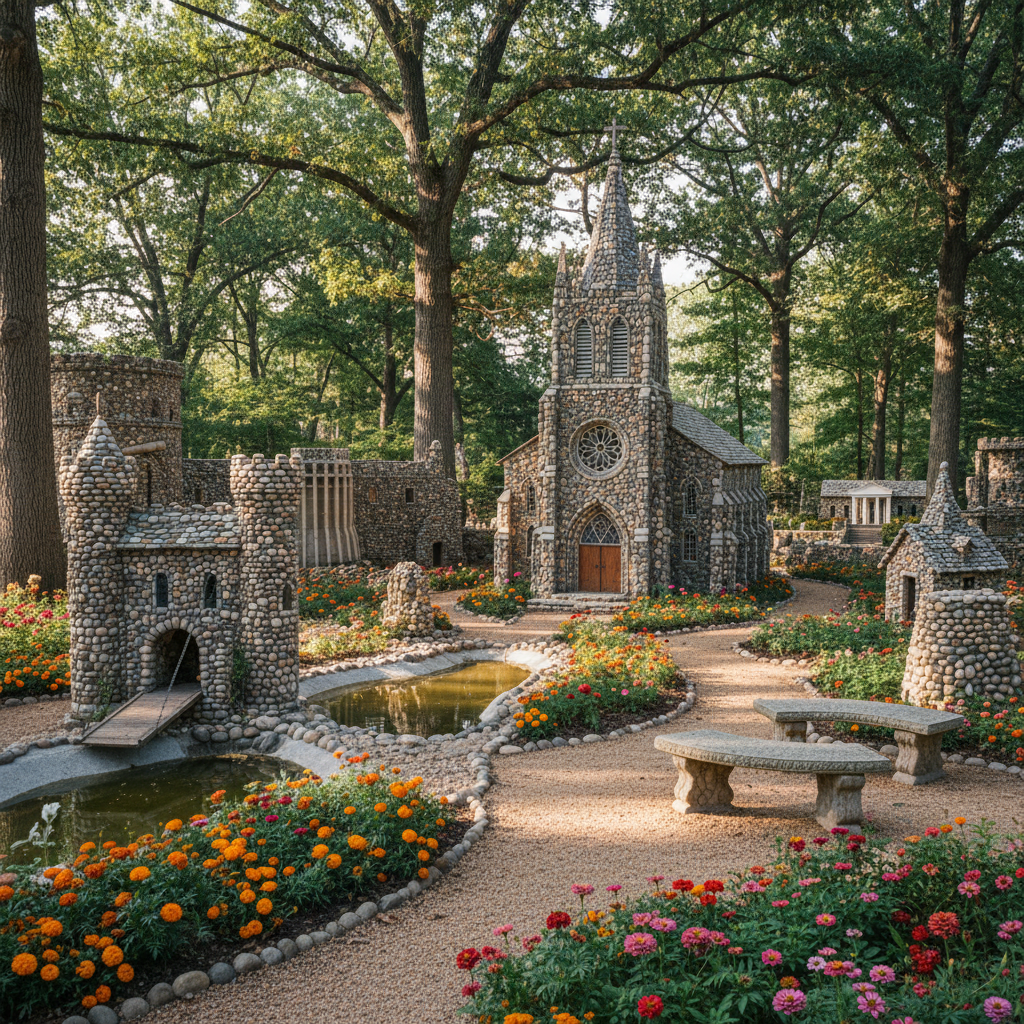 SPRINGFIELD • 1932–1939
Ben Hartman was a Depression-era foundry worker in Springfield who, in 1932, began building miniature structures in his backyard from stones he collected. Over the next seven years, he assembled one of the most remarkable pieces of outsider art in America.
The garden contains over 50 ornate miniature structures built from an estimated 250,000 individual stones. A 14-foot stone cathedral. A 12-foot castle with a working drawbridge and 107 windows. Scale replicas of the Hoover Dam and the White House. All built on a residential lot by a man with no formal art training, using rocks he gathered from creeks and construction sites.
The garden nearly disappeared. After Hartman's death, the property changed hands and deteriorated. In 2008, it was put up for auction with a starting bid of $56,000. The Kohler Foundation, which preserves significant works of self-taught art, stepped in and purchased the property, then spent years restoring Hartman's creations. The garden is now open to the public and maintained as one of Ohio's most important folk art sites.
Ohio's Museum of Weird: A Field Guide
The museums that could only exist in the Buckeye State
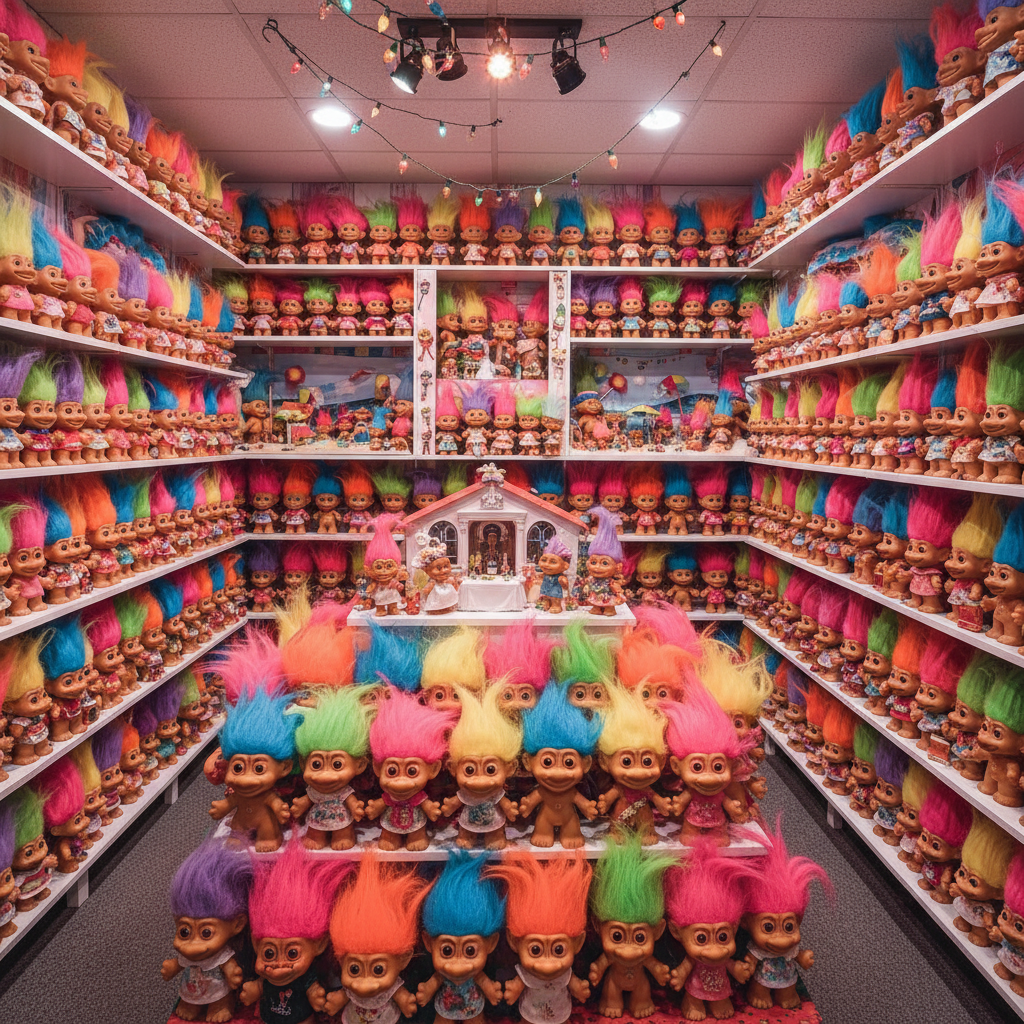 ALLIANCE • 20,000+ TROLLS
The Troll Hole Museum
Alliance, Ohio
Holds the Guinness World Record for the largest troll doll collection: over 20,000 items across 14 themed rooms. Shelly Kiszka started collecting in the 1960s and never stopped. The museum includes troll-themed rooms ranging from "Troll Beach" to "Troll Wedding Chapel." Yes, you can get married there. People have.
The Wyandot Popcorn Museum
Marion, Ohio
Houses the world's largest collection of restored popcorn poppers and horse-drawn popcorn wagons. Located inside the Marion County Heritage Center, the museum traces the evolution of popcorn vending from 19th-century street carts to the modern movie theater. Marion was once the popcorn capital of the world.
The Paul A. Johnson Pencil Sharpener Museum
Logan, Ohio
Displays 3,400 novelty pencil sharpeners in a tiny wooden cabin. Pencil sharpeners shaped like animals, buildings, vehicles, food, and objects that have no business being pencil sharpeners. One man collected them. Ohio made it a museum. This is how Ohio works.
The Buckland Museum of Witchcraft and Magick
Cleveland, Ohio
Claims to be the first museum of witchcraft in the United States. Founded by Raymond Buckland, a key figure in bringing Wicca to America, the collection includes ritual tools, ceremonial robes, and artifacts from multiple magical traditions. It operated for decades in private before going public.
The Cardboard Boat Museum
New Richmond, Ohio
Exists because the town holds an annual Ohio River Cardboard Boat Regatta — a race in which all boats must be constructed entirely from cardboard and duct tape. The museum preserves the most remarkable vessels from past races, including boats that successfully completed the course and boats that achieved spectacular, memorable failure.
The American Sign Museum
Cincinnati, Ohio
A 20,000-square-foot collection of American signage history — neon, painted, gilded, electrified. From early 1900s hand-painted signs to massive mid-century neon installations, the museum preserves the visual language of American commerce. Free guided tours on weekends.
The Merry-Go-Round Museum
Sandusky, Ohio
Located in a former post office, the museum houses antique carousel horses and a working carousel visitors can ride. You can also watch carvers creating new carousel animals by hand using the same techniques developed in the 1880s.
The Mound Cold War Discovery Center
Miamisburg, Ohio
The free public museum at the former Mound Laboratory — the underground nuclear facility that succeeded the Dayton Project. For decades, this was one of America's most classified workplaces. Now you can walk through the exhibits and learn about the atomic weapons triggers, tritium production, and nuclear spacecraft batteries that were built beneath a quiet Ohio suburb.
The National Museum of the U.S. Air Force
Dayton, Ohio • Free admission
The world's largest and oldest military aviation museum. Four massive hangars containing aircraft from the Wright Flyer to the Space Shuttle, stealth bombers, Air Force One planes, and experimental aircraft. Free admission. Plan for several hours. This is not a weird museum — it is a world-class one that happens to be in Ohio and happens to be free, which is, in its own way, very weird.
The Billy Ireland Cartoon Library and Museum
Ohio State University, Columbus
The world's largest academic research facility for cartoon and comic art, housing 450,000 original cartoons and 2.5 million comic strip clippings. From Yellow Kid to Calvin and Hobbes, the history of American comics lives in Columbus.
Natural Wonders That Shouldn't Be in Ohio
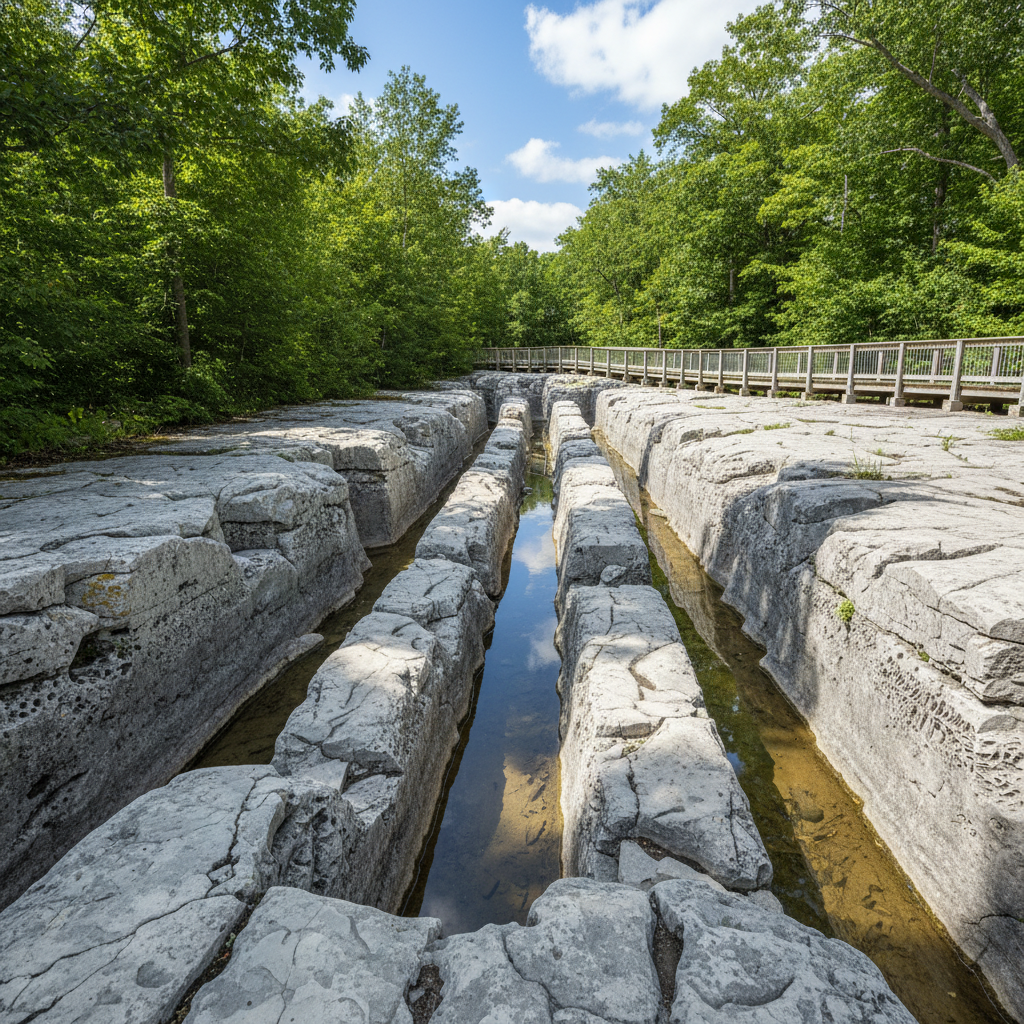 KELLEYS ISLAND • 18,000 YRS AGO
Ohio's landscape contains geological and ecological surprises that challenge the "flat cornfield" stereotype.
The Serpent Mound Crater
Beneath Serpent Mound in Adams County lies a 300-million-year-old meteorite impact crater, estimated at five to nine miles in diameter — the only known place on Earth where a space object collided with a pre-existing fault. The impact smashed seven cubic miles of rock. Compasses reportedly malfunction within the crater. Batteries drain. Severe storms reportedly dissipate at the rim. The famous Serpent Mound effigy — 1,348 feet long, the world's largest serpent effigy — was built directly on the crater's western rim.
The Oak Openings
Near Toledo, the Oak Openings Region is one of the rarest ecosystems on Earth, designated by The Nature Conservancy as one of the "Last Great Places." It contains Ohio's only native cactus (the eastern prickly pear) and the federally endangered Karner blue butterfly.
Kelleys Island Glacial Grooves
The world's largest accessible glacial grooves: 400 feet long, 35 feet wide, up to 10 feet deep, containing marine fossils 350-400 million years old. Carved by the Wisconsin Glacier, partially destroyed by limestone quarrying before preservation.
Cedar Bog (Actually a Fen)
In Champaign County, Cedar Bog — actually a fen, not a bog — contains plants from three different phytogeographic zones coexisting in a single location, fed by cool alkaline springs flowing through glacial gravel. It shouldn't work botanically. It does.
Goll Woods
In northwest Ohio, Goll Woods is a nearly virgin stand of the original Great Black Swamp forest, surviving only because the Goll family refused to sell their giant oaks when every other landowner in the region was clearing timber. Some trees are over 200 years old.