Hocking Hills State Park
Logan, Ohio • Hocking County • Southeast Ohio
Ask anyone in Ohio to name the most beautiful place in the state and the answer is almost always the same: Hocking Hills. This isn't debatable. It's not even close. Tucked into the foothills of Appalachian Ohio, Hocking Hills State Park is a landscape that makes first-time visitors stop mid-sentence and stare — because nothing about flat, unassuming Ohio prepared them for sandstone gorges, thundering waterfalls, and recess caves that look like they belong in a fantasy novel.
Old Man's Cave is the marquee attraction and the most visited site in the park. The trail descends into a deep gorge carved by Old Man Creek over thousands of years, passing through rock formations that tower overhead and narrow into passages barely wide enough for two people. The Devil's Bathtub — a swirling pothole worn into the gorge floor by centuries of water erosion — sits near the upper falls. Further along, Sphinx Head, a natural rock formation that genuinely resembles its namesake, juts from the cliff face like something deliberately sculpted. The gorge trail connects upper and lower falls and is, by any measure, one of the most spectacular short hikes in the eastern United States.
Ash Cave is the largest recess cave in Ohio, and standing beneath it is an experience that resets your sense of scale. The cave features a 700-foot horseshoe-shaped rim that arcs overhead, with a waterfall dropping from the lip into a pool below. In winter, the falls freeze into enormous ice columns, and photographers travel from across the region to capture it. The quarter-mile paved trail to the cave is fully accessible, making it one of the few genuinely dramatic natural sites in Ohio that anyone can reach.
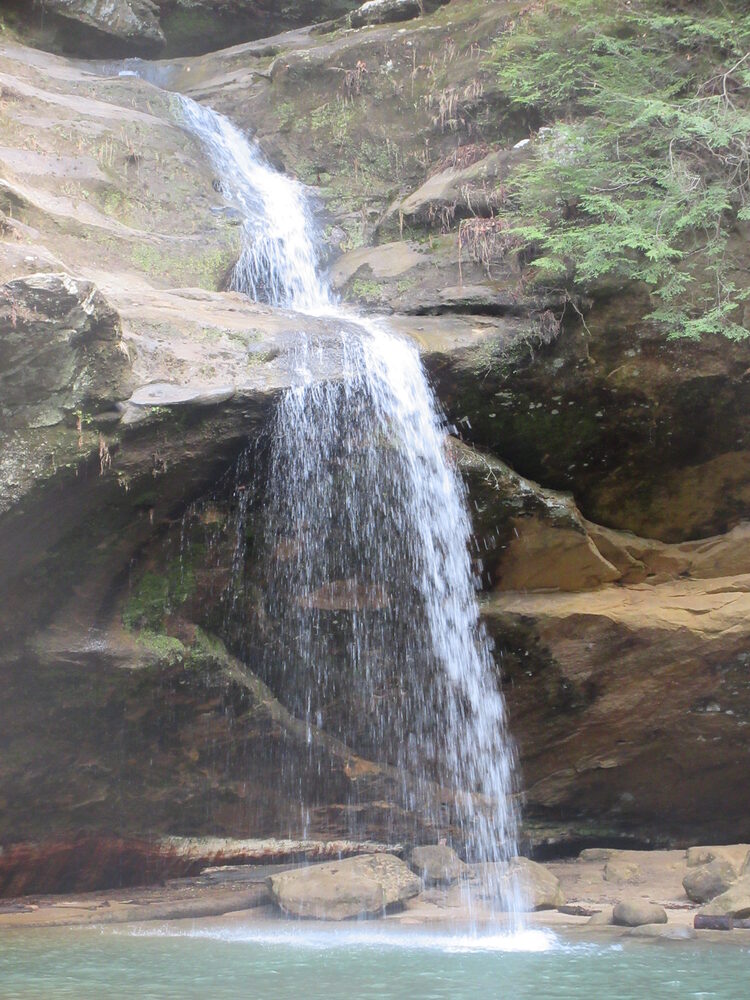
Cedar Falls is the largest waterfall by volume in the park, a broad cascade that roars after spring rains and maintains a steady flow even in drier months. Despite the name, the trees surrounding the falls are actually hemlocks — early settlers misidentified them as cedars, and the name stuck. Ohio being Ohio, nobody ever bothered to correct it.
Cantwell Cliffs, the most remote and least crowded of the major formations, rewards the effort to reach it with a narrow slot canyon, a rock shelter, and a quiet that the more popular trails can't match. And connecting it all is the Grandma Gatewood Trail, a six-mile path named for Emma "Grandma" Gatewood, the legendary Ohio woman who, at age 67, became the first woman to solo thru-hike the entire Appalachian Trail — wearing Keds sneakers and carrying a shower curtain for shelter.
Beyond the trails, Hocking Hills has evolved into a full outdoor adventure destination. Hocking Hills Canopy Tours operates one of the top-rated ziplining experiences in America, sending riders on cables above the forest canopy. Horseback riding outfitters take visitors through trails that cars can't reach. A growing cluster of wineries and tasting rooms dot the surrounding hills. And the camping — from primitive backcountry sites to luxury treehouses and cabins — keeps the region packed from spring through fall.
Cuyahoga Valley National Park
Between Cleveland & Akron • Ohio's Only National Park
Ohio has exactly one national park, and it's not where you'd expect it. Cuyahoga Valley National Park sits in the narrow corridor between Cleveland and Akron, a 33,000-acre stretch of forested river valley that somehow survived the industrial sprawl that consumed everything around it. It's the kind of place where you can be standing in wilderness so dense you'd swear you're a hundred miles from civilization — and then hear the faint hum of I-77 through the trees.
The park contains 125 miles of hiking trails, ranging from easy towpath walks along the old Ohio & Erie Canal to rugged ravine descents that will test your knees and your footwear choices. The Ledges Trail is the most popular and the most spectacular — a loop through massive Sharon conglomerate rock formations that rise like walls from the forest floor, creating narrow passages, overhangs, and a natural amphitheater called Icebox Cave that stays cool even in August.
Brandywine Falls, a 65-foot waterfall that drops over shale and sandstone ledges, is the park's most photographed feature. A boardwalk takes you to an overlook where the falls frame perfectly, and in autumn, when the surrounding maples and oaks ignite with color, the scene is genuinely postcard-worthy.
The Cuyahoga Valley Scenic Railroad runs through the heart of the park, offering train rides that follow the river's path and stop at trailheads along the way — you can hike one direction and ride the train back. It's one of the most civilized ways to experience a national park, and it's particularly popular during fall foliage season when the valley becomes a tunnel of red, orange, and gold.
The park's history has a dark chapter. Part of the parkland was assembled from the remains of Helltown — the Boston Township community that the federal government forcibly purchased and demolished in the 1970s through eminent domain, displacing families who had lived there for generations. The abandoned foundations, overgrown roads, and persistent legends of that ghost town are another story entirely. Today, nature has reclaimed what the demolition crews left behind.
Less known is the Botzum Mound, an unlisted archaeological site within the park that predates European settlement by centuries. The mound is not marked on visitor maps and receives little attention, which is, frankly, how the people who know about it prefer it.
 GREAT LAKE
Lake Erie & The Islands
Northern Ohio • 312 miles of shoreline
Lake Erie is Ohio's northern border, its freshwater ocean, and the reason the state's weather is as unpredictable as it is. But Erie is more than weather. It's an ecosystem, an economy, and an adventure destination that most Americans drastically underestimate.
Start with this fact: Lake Erie produces more fish than all other Great Lakes combined. Its shallow depth and warm waters create ideal conditions for walleye, perch, smallmouth bass, and steelhead trout. The walleye population alone supports a fishing industry that draws anglers from across the continent. Charter boats out of Port Clinton, Marblehead, and the islands stay booked through the season.
Put-in-Bay, on South Bass Island, is Lake Erie's crown jewel and Ohio's island getaway. Accessible only by ferry or small plane, the village is a concentrated blast of parasailing, kayaking, wine tasting, golf cart rentals, and a nightlife scene that punches wildly above its weight for a place with a year-round population of roughly 400 people. At its center stands Perry's Victory and International Peace Memorial, a 352-foot Doric column commemorating Commodore Oliver Hazard Perry's decisive naval victory during the War of 1812. You can take an elevator to the observation deck for panoramic views of the lake and the surrounding islands — on a clear day, you can see Canada.
Kelleys Island is Put-in-Bay's quieter, more nature-focused sibling. The main attraction is the Glacial Grooves — the world's largest accessible glacial grooves, carved by a massive glacier roughly 18,000 years ago. The grooves stretch 400 feet long and are scored into limestone that contains fossils 350 to 400 million years old. You're literally walking through a geological timeline that spans the better part of Earth's history. The island also offers excellent hiking, a small winery, and a pace of life that makes Put-in-Bay feel like Manhattan.
Beneath Kelleys Island and the surrounding lakeshores lie cave systems that extend into the bedrock. The most famous, Crystal Cave on South Bass Island, contains the world's largest geode — a story that belongs to Ohio's underground.
 THRILL ZONE
Cedar Point: The Roller Coaster Capital of the World
Sandusky, Ohio • Lake Erie peninsula
Cedar Point calls itself "The Roller Coaster Capital of the World," and no one has ever seriously challenged the claim. The park sits on a narrow peninsula jutting into Lake Erie near Sandusky, and its skyline of steel track and towering lift hills is visible for miles across the water — a mechanical mountain range rising from a Great Lake.
The numbers speak for themselves. Cedar Point has hosted some of the tallest and fastest roller coasters on the planet, and its collection of world-class steel and wooden coasters is unmatched by any single park anywhere. The lineup reads like a who's who of coaster engineering milestones: record-breaking heights, speeds that blur your vision, inversions that test the limits of what the human body finds entertaining.
For roller coaster enthusiasts, a trip to Cedar Point isn't a vacation. It's a pilgrimage. Coaster clubs organize annual trips. Enthusiasts travel from Europe and Asia specifically to ride here. The park's combination of sheer coaster quantity, ride quality, and the dramatic Lake Erie setting creates an experience that no other amusement park can fully replicate.
Cedar Point has been operating since 1870, making it one of the oldest amusement parks in existence. It started as a beach resort and beer garden on the peninsula and evolved, decade by decade, into the thrill-ride mecca it is today. The fact that it has survived wars, depressions, and the rise and fall of countless competitors says something about the hold it has on the people who visit. You go once, and the peninsula calls you back.
Serpent Mound & the Meteor Crater
Peebles, Ohio • Adams County
In a clearing in rural Adams County, on a bluff above Brush Creek, lies one of the most mysterious structures on the continent. Serpent Mound is a 1,348-foot effigy mound shaped like an uncoiling serpent, its jaws open wide around an oval shape that may represent an egg, the sun, or something no living person can definitively identify. It is the largest serpent effigy in the world.
The mound is ancient. Debate continues about whether it was built by the Adena culture (roughly 300 BCE) or the Fort Ancient culture (roughly 1070 CE), but what's beyond debate is that whoever built it chose this location with extraordinary precision. Serpent Mound sits directly on top of a 300-million-year-old meteor impact crater — a cryptoexplosion structure roughly five miles in diameter that shattered the bedrock beneath the site millions of years before any human set foot in Ohio.
And then there are the anomalies. Visitors and researchers have reported that compasses malfunction near the mound, spinning or pointing inconsistently. Batteries drain at unusual rates. Some claim that storms seem to dissipate as they approach the site, splitting and reforming after passing over it. Whether these phenomena are genuine geomagnetic effects of the underlying impact structure, confirmation bias, or something else entirely, they've attracted the attention of researchers and earned Serpent Mound consideration for UNESCO World Heritage Site status.
The full story of Serpent Mound's strangeness — and the other natural anomalies scattered across Ohio — goes deeper than any single visit can reveal.
"Ohio has 75 state parks, one national park, one national forest, and 312 miles of Great Lake shoreline. The state that everyone pictures as flat farmland contains more than enough wilderness to humble anyone willing to look for it."